Somewhere along the way, "meet new people online" became synonymous with pointing a camera at your face. It never had to. Text was the internet's original way of talking to strangers, and it's quietly having a comeback — for privacy reasons, for sanity reasons, and because typed conversations are simply better at becoming real ones. (Disclosure: this guide is by the team behind stdout.chat, a text-only chat app. Bias declared, honesty attempted.)
01 / THE LISTApps and sites to talk to strangers without video, compared
Text-first, no camera in the loop, verified alive in September 2026, one honest con each:
- stdout.chat (iOS app, free) — one-on-one text chat matched by shared interests, no sign-up, ephemeral sessions, one-tap report and block, 18+. Con: iOS only, and deliberately not a firehose — you're paired with people who share an interest, not with everyone online. (This is us.)
- TalkWithStranger (web) — topic-based text chatrooms, no login, running for years. Con: dated interface; public rooms give ambient company more than one real conversation.
- AntiLand (iOS/Android) — anonymous group rooms with a karma system, no registration. Con: chaotic by design; good for banter, weak for depth.
- Whisperly and AirTALK (web) — voice plus text, no video. Con: you're still audible, which is its own kind of exposure; if you want pure typing, see our Whisperly alternatives.
- Wakie (iOS/Android) — topic-based voice calls with strangers. Con: voice-only, account required.
- Emerald Chat, text mode (web) — a video roulette with a text-only mode. Con: the text queue is the video crowd with the camera off; bots and "asl?" at roulette levels.
- StrangerLine (web) — text, voice and video with no sign-up and a reconnect feature. Con: video in the mix, so the text queue inherits it.
Apps to approach with eyes open: MeetMe leans dating and requires an account; Connected2.me has required a profile photo — which defeats the faceless point entirely. The Omegle-shaped version of this question, clones named and "unmoderated" explained, is in Omegle alternatives for text chat only.
02 / THE SHIFTWhy text-first is having a moment
Three things converged. Video roulette burned a generation of users — the two-second skip, the exhibitionists, the feeling of being on stage uninvited. Privacy caught up as a mainstream concern: people got pickier about who sees their face and where it might end up. And a wave of camera-free platforms appeared to catch the exodus, from voice-and-text hybrids to pure typing.
The deeper reason is older than all of that: text flattens the noise. No appearance, no accent, no bedroom in the background — just whether the other person is interesting. For meeting genuinely new people, that's not a downgrade from video. It's the point.
03 / CHECKLISTWhat to look for before you type a word
- No sign-up, no phone number. If an "anonymous" platform wants your number, walk. The genuinely no-registration options are listed in our no-phone-number guide.
- Real humans. The bot problem is worst on free web roulettes, where nothing stops a script from opening a thousand tabs. Native apps with device identity and moderation have structurally fewer bots. If the first message arrives instantly and reads like a flyer — next.
- An enforced 18+ policy. Stranger chat is an adult format, and platforms that pretend otherwise are repeating Omegle's fatal mistake.
- Moderation with teeth. One-tap report and block, and bans that actually stick (device-level, not cookie-level).
- Something to match on. Purely random pairing is a slot machine. Topic rooms or interest matching raise the floor of every conversation.
04 / EXPOSUREText vs voice vs video: what each one leaks
Think of it as an exposure ladder. Video leaks everything: face, room, reactions, recordable footage. Voice drops the visuals but keeps your actual voice — identifiable, recordable, harder to un-share. Text leaks only what you choose to type, and on an ephemeral platform, not even that survives the session.
There's a corollary people miss: the less you expose, the longer you last. Video-chat fatigue is real because performing is tiring. Typing from your couch costs almost nothing, which is why text conversations happen at hours and moods video never reaches.
05 / TECHNIQUEGetting conversations that don't die in a minute
Wherever you talk, three habits separate the good sessions from the churn:
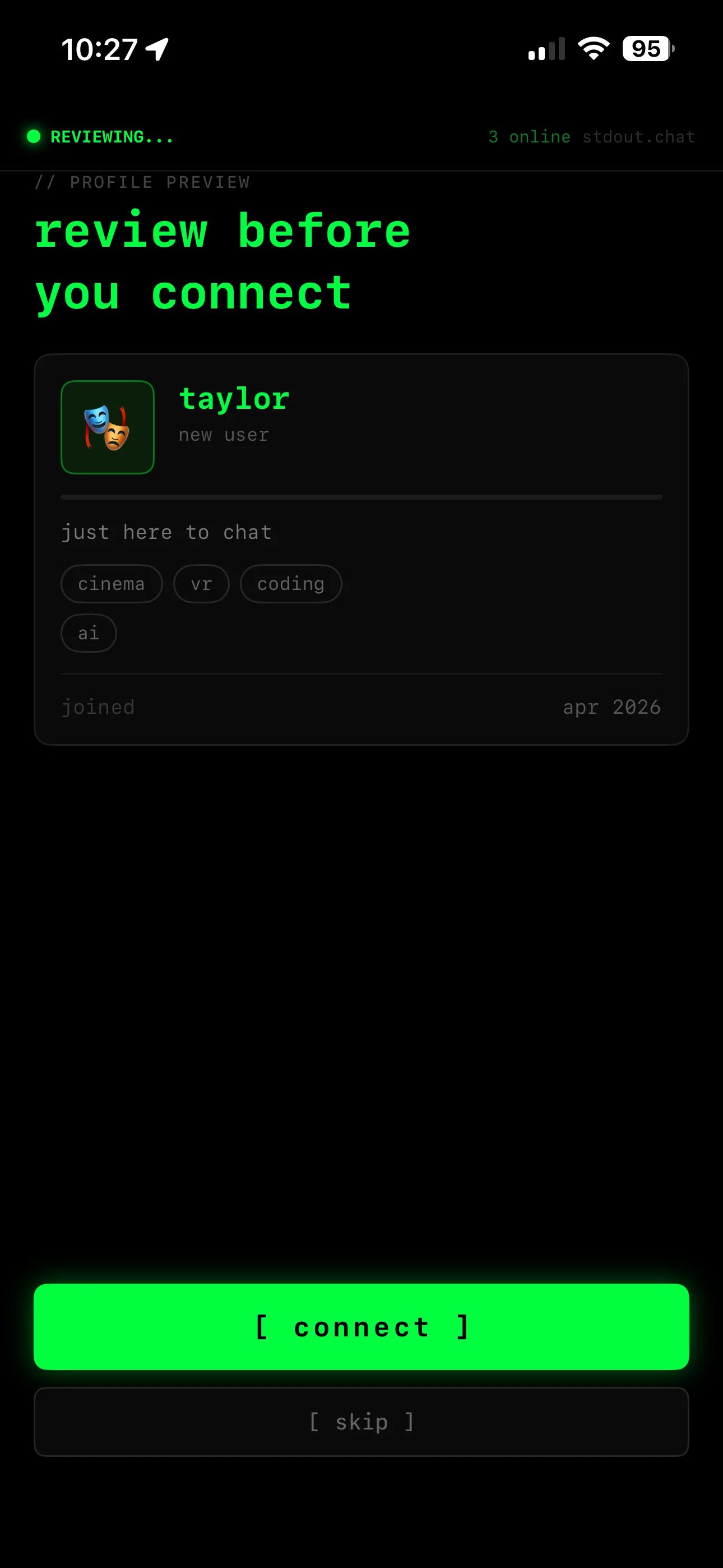
- Match on something. On stdout.chat you pick up to five interests and see the overlap before connecting — choose specific ones. "Music" matches everyone; the conversations start better when the tag is closer to what you actually love.
- Open with the overlap. Never bare "hey". React to the shared interest, add one detail of yours, end with an easy question. Our ninety starters, sorted by interest, exist for exactly this moment.
- Leave cleanly, early. A conversation that isn't working after three exchanges won't be saved by ten more. Skip without guilt — the next match costs nothing. Where conversation quality is graded, like stdout.chat's rank ladder, ending politely beats ghosting.
06 / RED FLAGSThe short list that prevents most bad outcomes
- Anyone rushing you off-platform ("add me on …" in the first minutes) — the standard first move of scams. On-platform there's moderation; in your DMs there's none.
- Anyone asking for photos, money, or your socials — conversation doesn't need any of them. Sudden sob stories with payment links are a script, not a person.
- Oversharing by momentum. Anonymity is yours to keep or lose: no last name, no workplace, no neighborhood details. The platform can't leak what you never typed.
- Platforms with no visible rules. If you can't find the report button or an age policy in one minute, that's the review.
07 / FAQQuestions people actually ask
Is talking to strangers online safe?
On moderated 18+ platforms, with the red-flag list above respected — yes, reasonably. Text-only platforms are structurally safer: nothing to record, nothing to leak.
Can chats be traced?
By strangers — not if you don't overshare. By platforms — technical data like IPs exists everywhere online; it's what makes bans work.
Which apps are 18+?
Check every platform's stated policy; stdout.chat is 18+ with age gating. No stated policy — no download.
How do I actually start?
Shared thing → small personal detail → easy either/or question. Ninety worked examples here.
Is there an app to text strangers like Omegle, without the camera?
Yes — that's the list in section 01. For one-on-one, interest-matched text with no sign-up: stdout.chat. For browser rooms: TalkWithStranger. For the full roulette-era comparison: Omegle alternatives for text chat only.
08 / TRY ITStrangers, minus the stage
The best version of talking to strangers was never about seeing them — it was the conversation you didn't know you needed with someone you'll never have to impress. That takes a text box, a shared interest, and nothing else.
