If video calls drain you, if you rehearse sentences before saying them, if "just hop on a quick call" makes your chest tighten — none of that means you don't want people in your life. It usually means the opposite. This guide is about the growing set of ways to meet people online with the camera permanently off. (Disclosure: it's written by the team behind stdout.chat, one of the apps in that set.)
01 / PERMISSIONWhy talking is easier when nobody can see you
Face-to-face conversation — including video — is a multitasking exercise: you're composing thoughts while managing eye contact, posture, facial expression, lighting, and the nagging thumbnail of your own face. For a lot of people, that overhead consumes exactly the energy the conversation needed.
Text removes the overhead. Nobody sees you, so there is nothing to perform. You can think for ten seconds before replying and nobody watches you think. You can talk at 2am from under a blanket. The quieter, more deliberate people — the ones video chat steamrolls — suddenly get a fair start, because the only thing being judged is what you actually say.
02 / PRESSURE AUDITWhat makes an app genuinely low-pressure
"No video" is necessary but not sufficient. Plenty of camera-free apps rebuild the pressure through other channels. Before trusting one, audit it:
- No profile photos. If the app leads with faces, appearance is back on the table before a word is typed. Photo-forward friend apps repeat the problem they claim to solve.
- No public metrics. Follower counts and like tallies turn conversation into scoreboard. An app can't be low-pressure if it ranks you socially in public.
- No permanence. Knowing every message lives forever is its own stage fright. Ephemeral chats mean a clumsy sentence evaporates instead of haunting you.
- An exit that costs nothing. Ending a conversation should be one tap, no explanation owed. Guilt-free exits are what make starts feel safe.
03 / OPTIONSApps to meet people without showing your face, compared
- stdout.chat (iOS, free) — text-only one-on-one chat matched by shared interests. No photos anywhere in the app, no follower counts, ephemeral sessions, no sign-up. Built for exactly this use case — which is why we built it.
- Slowly (iOS/Android) — pen-pal letters with delivery delay based on distance. Beautifully low-pressure pacing; the trade-off is that a reply can take a day, so it's correspondence, not conversation. More in our pen pal apps guide.
- 7 Cups — free peer-support chat with trained listeners. Good when you need to be heard; it's support, though, not friendship on equal footing.
- We3 / group-matching apps — match you into small groups, which some people find easier than one-on-one. Registration and profiles required.
- BFF-style friend finders — mainstream friendship apps work for many people but are photo-first by design: your picture is the front door. If cameras are the problem, they're the same problem in different packaging.
Broader comparisons — including anonymous web chats — live in our guide to chat apps that match by interests and the list of apps that don't ask for a phone number.
04 / SMALL TALKInterest matching kills the worst part
The hardest moment of talking to someone new isn't the middle of the conversation — it's the blank start. "So… where are you from?" is the sound of two people with no known common ground trying to find some on live television.
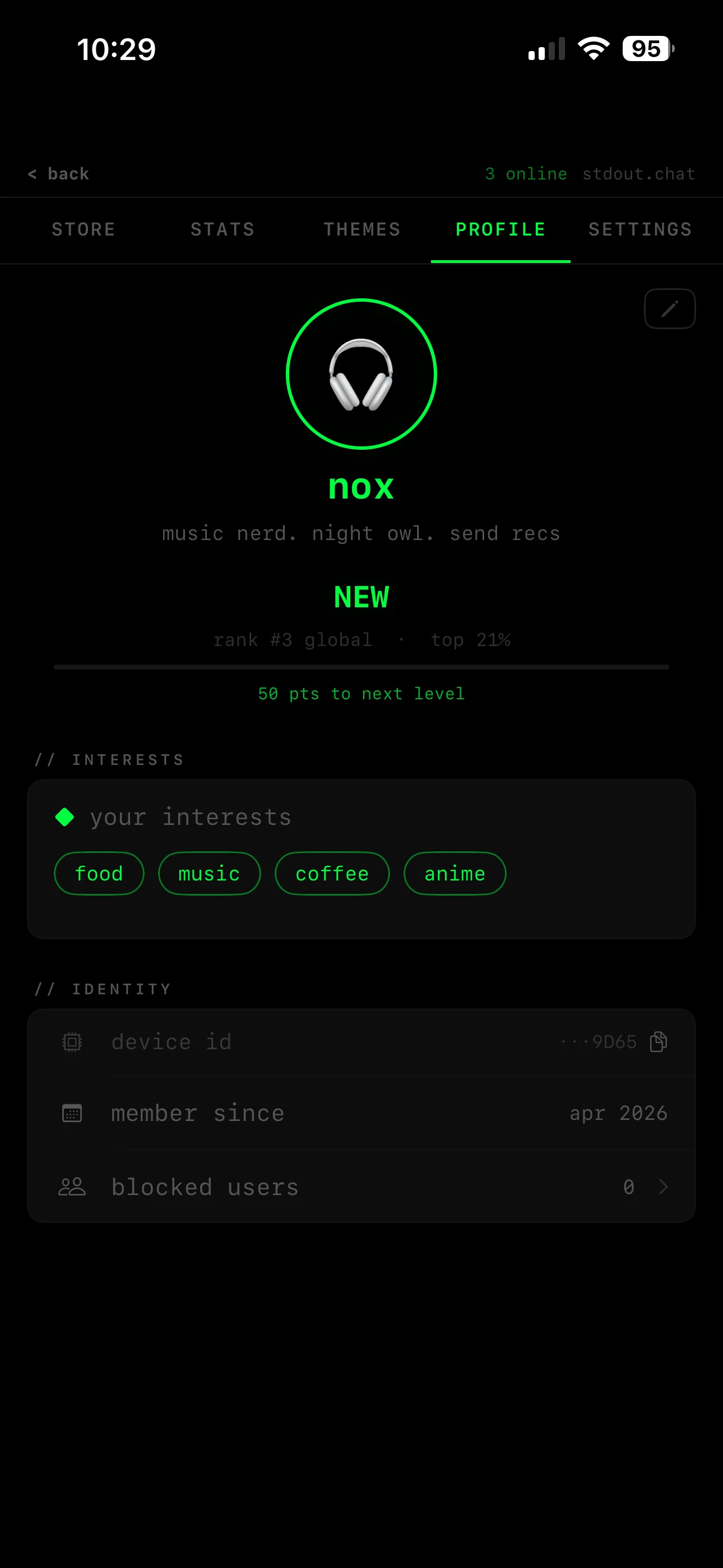
Interest matching removes that moment. On stdout.chat you pick up to five interests, get paired with someone who shares at least one, and see the overlap before the chat starts. The first message writes itself, because you already know one thing you both care about. For the anxious brain, that's the difference between a cold open and a script.
05 / FIRST LINEGentle openers that don't feel like performance
Three rules cover most of it: don't open with a bare "hey" (it hands the other person all the work), mention the thing you share, and end with a question that's easy to answer. A shape that works: react to the shared interest, add one small personal detail, close with an either/or.
"Matched on music — I've had the same album on loop all week. Do you go deep on one artist or shuffle everything?"
That's it. No wit required, no essay. We keep a full list of conversation starters organized by shared interest if you want more than the formula.
06 / HONESTYApps alongside support, not instead of it
One honest caveat. Text-first apps lower the cost of practice, and practice genuinely helps — but an app is practice space, not treatment. If anxiety is shrinking your daily life — work, school, leaving the house — that deserves real support from a professional, and resources like the National Institute of Mental Health are a good starting point. The app is where you warm up. It shouldn't have to be the whole world.
07 / FAQQuestions people actually ask
Can apps actually help with social anxiety?
They can lower the cost of practicing — no faces, no audience, no permanent record. Practice space, not treatment: see the caveat above.
Are there apps to make friends without photos?
Yes — stdout.chat has no photos anywhere, and letter apps like Slowly de-emphasize them. Most mainstream friend finders are photo-first.
Is it weird to prefer texting over video?
No. It's a preference with good reasons behind it — time to think, no appearance anxiety, equal footing — and entire apps are now built around it.
How do I start when I'm anxious?
Lead with the thing you share: react, add one small detail, ask an easy either/or. The starters list has ninety ready to use.
08 / TRY ITThe lowest-stakes first step
No account, no photo, no camera, and a conversation you can leave at any moment without explaining yourself. If meeting people has felt like too much, this is the smallest possible version of it — small enough to actually start.
